AI Visibility Audit

AI Visibility Audit

Do you know what ChatGPT says about your business when a customer asks? We do, with screenshots.

We ask the real questions your customers ask, across ChatGPT, Google AI Overviews, Google AI Mode, Perplexity, Gemini, and Copilot, and we capture what comes back. Then we score your business against a fixed five-pillar rubric and hand you a report that says what is wrong, what it costs you, and exactly how to fix it.

A standalone engagement. You do not need to be a client, and nothing about it obliges you to become one.

Who is the AI Visibility Audit for?

Businesses whose customers have started asking an AI tool before they ask anyone else, and who have no idea what that tool is telling them.

The most common trigger is a specific and unsettling pattern: organic traffic softening with no ranking drop to explain it. Your position report looks fine. Your analytics do not. That gap is usually where an AI answer has been inserted above the results, and the customer got what they needed without scrolling.

Google AI Overviews now appear on 48% of all Google queries (SE Ranking and SeoProfy, 2026), and top organic results are seeing click-through fall by 15 to 46% (multiple studies, 2025 to 2026). Google AI Mode, which is a separate conversational surface, ends 93% of its sessions with no click to any website at all (Semrush, 69 million sessions, 2026). Your ranking can be perfect and irrelevant at the same time.

Local and service businesses whose classic search traffic has softened. Professional firms in categories where being recommended matters more than being found. Companies already spending on SEO or content who want to know whether any of it reaches the new surfaces. And owners who simply want to see, once, what the machine says about them.

What do you actually get?

A branded report with an evidence appendix, a walkthrough call, and eight things inside it. It covers everything a serious AI visibility audit is expected to cover in 2026: share of voice, mention rate, citation rate, sentiment and accuracy, competitor comparison, coverage by service category, and a prioritized fix list. Every client-facing finding is verified by a human before it reaches you.

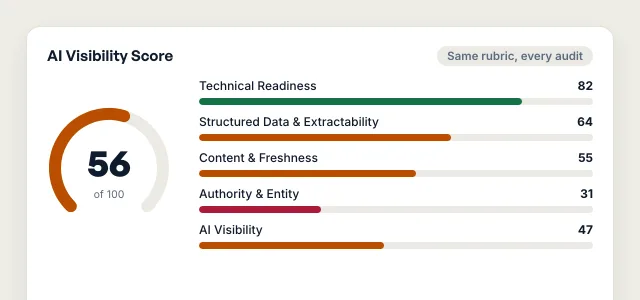
Your AI Visibility Score, across five pillars

Technical Readiness, Structured Data & Extractability, Content & Freshness, Authority & Entity, and AI Visibility. Each carries equal weight in the composite. The same rubric is applied to every business we audit, so the number means the same thing every time, and it is the number a recheck moves.
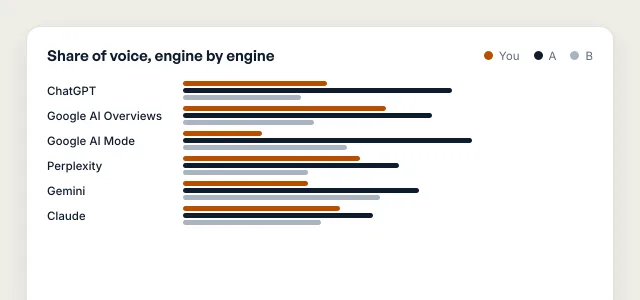
Your share of voice, engine by engine

How often you are named when a customer asks, on each surface separately, next to your direct competitors on the identical questions. Not one blended figure: ChatGPT and Google AI Mode can give completely different answers about you, so a single average would hide the thing you most need to see.

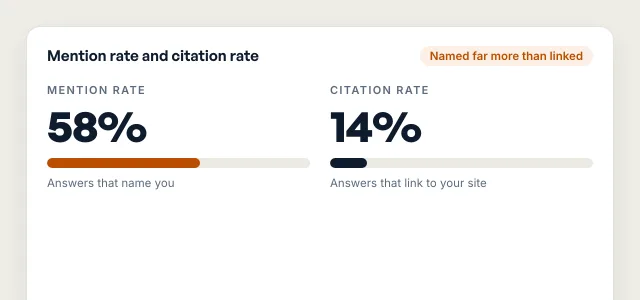
Mention rate, citation rate, and the gap between them

Being named and being linked are different outcomes and they get measured separately. Across the industry only 23.1% of AI brand mentions carry a citation back to the brand's own domain (BuzzStream, 12,000 AI responses, 2026), so most businesses are being talked about far more than their analytics suggest. A mention builds recognition and sends nobody. A citation sends a visitor. Knowing which one you are getting decides whether your next move is off-site presence or on-site content, and those are very different budgets.

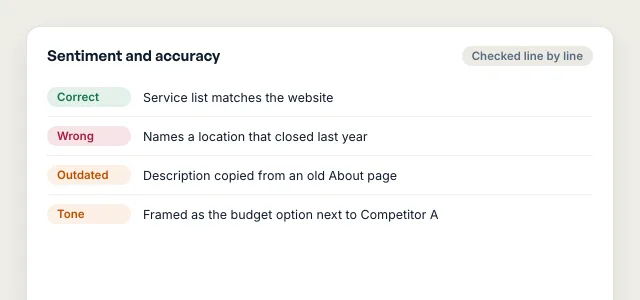
Sentiment and accuracy, checked line by line

Not just whether you come up, but whether what is said is correct and how it makes you sound. Wrong service lists, wrong locations, an outdated description, or a tone that positions you below a competitor. Inaccuracies are usually the fastest thing to fix and the most expensive thing to leave.

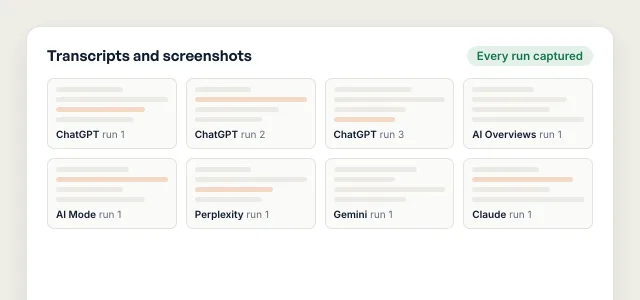
The transcripts and screenshots

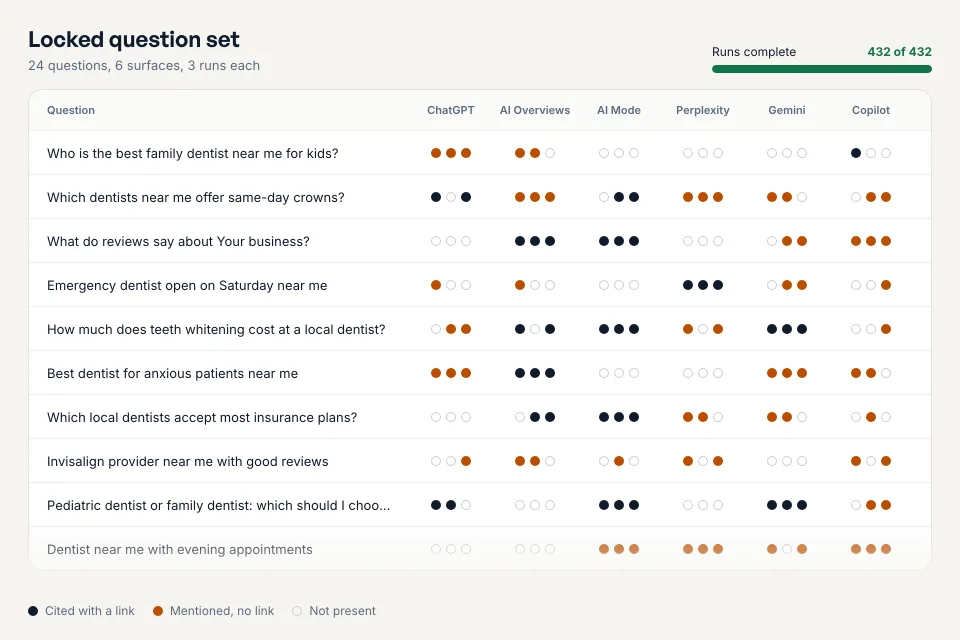
Every question we asked, every answer that came back, on every surface, captured. This is the part clients read first and the part they forward internally. It is also the part that cannot be faked or argued with.

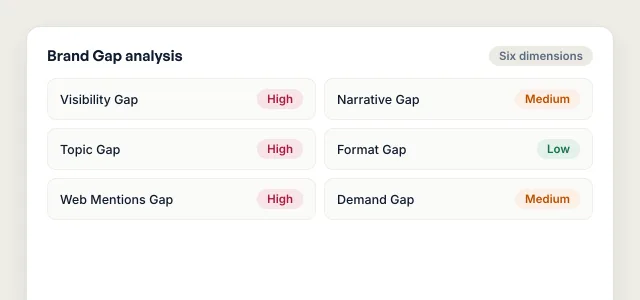
A Brand Gap analysis across six dimensions

Visibility Gap, Narrative Gap, Topic Gap, Format Gap, Web Mentions Gap, and Demand Gap. Where you are not mentioned, where you are described wrongly, where you have no recognized authority, what formats you are missing, which third-party sources omit you, and which searches you are absent from. Topic Gap doubles as your coverage map: which of your service categories AI already associates with you, and which it does not.

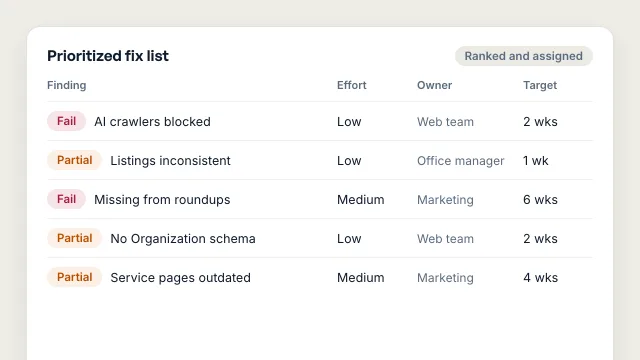
A prioritized fix list, ranked and assigned

Every failed check arrives with six things: the finding in plain English, the business consequence, the specific fix, the effort it takes, who should own it, and a target date. Whoever is going to do the work can start on Monday without a translation meeting. No finding ships as a bare score, because a diagnosis with no prescription is not worth paying for.

A walkthrough call

We take you through the findings, answer the objections in the room, and leave the report and the evidence with you.

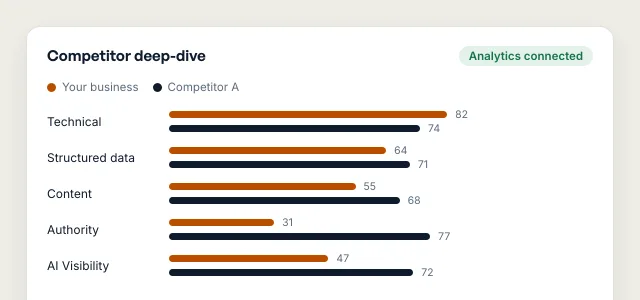
AI Visibility Audit Pro adds three things. Your own analytics integrated into the picture, so AI referral traffic sits alongside what the probes found. An additional answer surface added to the probe set. And a competitor deep-dive rather than a share-of-voice comparison: one named rival, taken apart, with what they are doing that puts them in the answer ahead of you.

It fits competitive categories and businesses that need the gap against one specific rival rather than against the field.

How does the audit work?

Six stages. Three of them are machine work, which is what keeps it affordable. Three of them are human checkpoints, which is what makes it trustworthy.

  1. 01

    Stage 1: we agree the questions

    We draft the set of questions a real customer would ask to find a business like yours, and you approve it before anything runs. Then the set is locked. Locking it is what makes every future recheck a real comparison rather than a fresh opinion.

  2. 02

    Stage 2: the technical and content scan

    An automated crawl checks whether AI systems can reach and read you at all. Whether AI crawlers are blocked in robots.txt or by your CDN. Whether your pages still contain content when JavaScript is off, because the crawlers behind AI answers largely do not run it. Whether your schema declares who you are. Whether your content is recent enough to be cited.

  3. 03

    Stage 3: probing the answer surfaces

    Every approved question is run three times per surface, because these systems do not give the same answer twice and a single run is an anecdote. Transcripts are captured automatically, and the surfaces that require a real browser session are probed by hand against a written protocol.

  4. 04

    Stage 4: the authority sweep

    Most of what decides whether AI recommends you does not live on your website. It lives in the third-party sources these systems trust: directories, roundups, review platforms, your Google Business Profile, and the consistency of your name and details across all of them. A crawler cannot score this, so a person checks it.

  5. 05

    Stage 5: findings review

    A strategist verifies every client-facing finding against the underlying evidence before the report is generated. This checkpoint is not optional and not delegated. One wrong claim in a report like this costs more credibility than the entire audit earns.

  6. 06

    Stage 6: report and walkthrough

    The report is produced with its evidence appendix, and we walk you through it. Then it is yours to act on, with us or without us.

Plenty of tools will hand you an AI visibility score in ninety seconds. The number is cheap because nobody checked it. We would rather take days and stand behind every line, because the whole value of this report is that you can act on it without verifying it yourself first.

Is this the right fit?

An audit is worth buying when you have a real presence to measure and an intention to act on what it finds. Missing either one, and there are cheaper ways to spend the money.

Right for you if

  • Your organic traffic has softened and your rankings have not moved
  • You have a website with real content on it and a business that customers search for by category
  • You want evidence you can act on, not a score in a dashboard
  • You would rather know what AI says about you than assume
  • You are prepared to fix things, whether with us or with your own team

Maybe not yet if

  • Your site is brand new with almost no content. There is nothing for an AI system to cite yet. Publish for a quarter, then audit.
  • You have no Google Business Profile and no listings anywhere. Those are prerequisites, they are cheaper than an audit, and we would only be charging you to discover their absence.
  • You need a guaranteed position in ChatGPT. Nobody can sell you that. What we sell is a measurement and a fix list.
  • You want the report but have no intention of acting on it. The audit is genuinely worth buying alone, but a score nobody acts on changes nothing, and we would rather say that before you pay than after.

If you are unsure which side you fall on, ask on the call. A Lite Scan is the cheaper way to find out whether the full audit is worth it, and we will point you there if it is the honest answer.

What does the engagement look like?

A standalone, fixed-scope engagement with a report at the end of it. You do not need to be a client, and buying one obliges you to nothing.

What it isA standalone, fixed-scope engagement. You do not need to be a client.
Surfaces coveredChatGPT, Google AI Overviews, Google AI Mode, Perplexity, Gemini, and Claude. Microsoft Copilot is added for business-to-business and enterprise-buyer categories.
Question setDrafted by us, approved by you, then locked so future rechecks are comparable
Runs per questionThree per surface, because these systems do not answer identically twice
Your timeOne scoping conversation, one approval of the question set, and the walkthrough call
DeliverableA branded report with an evidence appendix, a five-pillar composite score, a six-dimension Brand Gap analysis, and a prioritized fix list
Reporting cadenceQuarterly Recheck by default. Monthly reporting is available inside a Tier 2 Growth engagement, where there is ongoing work to report on.
What happens afterNothing, unless you want it. Remediation is quoted separately in three tiers, and you can implement the fix list yourself.
PricingQuoted after scoping. We do not publish a number.

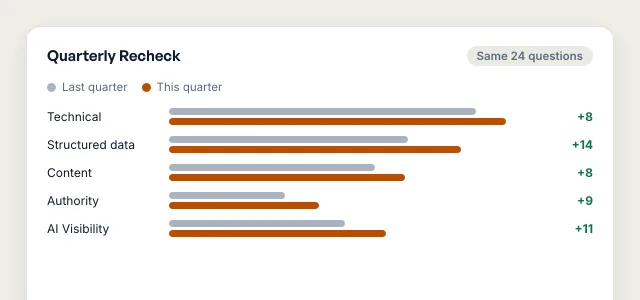
The most useful thing about a locked question set is what it lets you do in ninety days. A Quarterly Recheck reruns the identical rubric against the identical questions and reports the delta, so the effect of the work is visible rather than asserted. That is the difference between reporting and proving.

Questions about the audit.

What does an AI visibility audit include?

A five-pillar score covering Technical Readiness, Structured Data & Extractability, Content & Freshness, Authority & Entity, and AI Visibility. A locked set of your customers' real questions, run three times each across ChatGPT, Google AI Overviews, Google AI Mode, Perplexity, Gemini, and Claude, with every transcript and screenshot captured. A Brand Gap analysis across six dimensions. Every failed check paired with its business consequence and its specific fix. And a walkthrough call.

How do you know what ChatGPT says about my business?

We ask it, on the record, and keep the receipts. Not once, but three times per question, because these systems vary between runs and a single answer proves nothing. Surfaces that need a real browser session are probed by hand against a written protocol. Every transcript and screenshot ships in the evidence appendix, so you can check our work rather than trust it.

Do I need to be a client to buy an audit?

No. The audit is sold standalone and a large share of the businesses that buy one never become clients. The report is written to be acted on by your own team if that is what you prefer, and the fix list names the work rather than only naming us.

How is this different from a free AI visibility grader?

A free grader runs an automated check and returns a number. Nobody verifies it, nothing is probed by hand, and no fix is attached. Our audit combines automated scanning with manual probing across every surface, and a strategist verifies every client-facing finding against the evidence before you see it. You are paying for the verification and the fix list. The score is the cheap part.

Will you also fix what you find?

Yes, if you want us to, and remediation is quoted separately in three tiers. But the report is deliberately written so that your own team or another firm could execute it. A fix list only we can act on is not a deliverable, it is a dependency, and you did not buy a dependency.

How often should we redo this?

Quarterly is the natural rhythm, because that roughly matches how fast the freshness signal decays: 50% of AI citations come from content published or updated within the last 13 weeks (Amsive, 2025). A Quarterly Recheck reruns the same rubric and the same locked questions and reports the delta.

Do we get a dashboard we can log into?

No, and it is a deliberate choice rather than a missing feature. Continuous monitoring platforms exist, they are good, and they are built for teams who already have the people to act on what a dashboard surfaces. Most of the businesses we audit do not, so a dashboard becomes one more tab nobody opens. What you get instead is a report a person verified, a fix list with owners and dates, and a rerun on the same locked questions when you want to see whether it moved. If you would rather have live monitoring, we will tell you which platform to buy and help you read it.

How often should this be rerun, and can we get monthly reporting?

Quarterly is the default, because that is roughly how fast the freshness signal decays and it is long enough for remediation work to actually show up in the answers. Rerunning monthly against a category that has not changed mostly measures noise. Monthly reporting is available inside a Tier 2 Growth engagement, where there is continuous work to report on. For a standalone audit, quarterly is the honest cadence and we would rather say so than sell you twelve reports a year.

See what AI says about your business.

Most owners have never once seen what ChatGPT returns when a customer asks for a business like theirs. We will show you, with the transcripts attached, and tell you honestly whether what we found is worth fixing.

We reply within one business day. If a Lite Scan would answer your question for less, we will tell you that instead.