Technical Readiness
Can AI crawlers reach your site, and does your page still have content when JavaScript is switched off?
10 checks
We measure exactly what ChatGPT, Google AI Overviews, Google AI Mode, Perplexity, Gemini, and Copilot say about your business when a customer asks, then fix what is keeping you out of the answer.
Six named surfaces, a locked set of the questions your customers actually type, three runs per question, and screenshots of every result. You will see what we saw.

Answer engine optimization, or AEO, is the work of making your business the source an AI system cites when it answers a customer's question. Traditional SEO competes for a position in a list of links. AEO competes to be inside the answer itself, which is a different job with different mechanics.
The mechanics differ from SEO in three ways that matter.
Your website is not the only thing being read. It matters enormously, and everything below assumes you are fixing it. But 80% of AI citations come from third-party sources rather than a brand's own content (BuzzStream, 12,000 AI responses, 2026): directories, review platforms, industry roundups, community discussion, and video. Wikipedia and Reddit alone drive over 25% of ChatGPT's US citations (5W Research, 2025).
They extract from structure rather than reading a page top to bottom, so how a page is organized affects whether it can be quoted at all.
They strongly prefer recent material. 50% of AI citations come from content published or updated within the last 13 weeks (Amsive, 2025).
Because the answer is being given without you. The customer got what they needed on the results page, or inside a chat, and never reached the list your ranking lives in.
Google AI Overviews now appear on 48% of all Google queries (SE Ranking and SeoProfy, 2026), and top organic results are seeing click-through fall by 15 to 46% (multiple studies, 2025 to 2026). Your position did not move. The thing above your position did.
Google AI Mode ends 93% of its sessions with zero clicks to any external site (Semrush, 69 million sessions, 2026). Google AI Mode is a separate conversational surface from Google AI Overviews, not a different name for the same feature.
The two cite the same URLs only 13.7% of the time (Ahrefs, 540,000 query pairs, 2025), which means being cited in one is close to no evidence that you are cited in the other.
The other half of the story
The traffic that does arrive from AI search is better than what it replaced. Visitors referred by AI convert at 4 to 5 times the industry average (Ahrefs and Semrush, 2025), because they arrive already recommended rather than still comparing. Fewer visits, better visits. That is the trade, and it only works in your favor if you are the business being recommended.
Two different things happen when an AI system talks about your business, and only one of them reaches your reporting.
A citation is a clickable link to your site. It sends a visitor, and that visitor is counted.
A mention is your name appearing in the answer with no link attached. Only 23.1% of AI brand mentions include a citation back to that brand's own domain (BuzzStream, 12,000 AI responses, 2026), so most of the time what you get is a mention. It sends nobody directly and your analytics record nothing at all. But the customer now has your name. What they usually do next is search for you, or type your address straight in, at which point your own reporting files them under branded search or direct traffic. The answer that actually produced the customer gets credited nowhere.
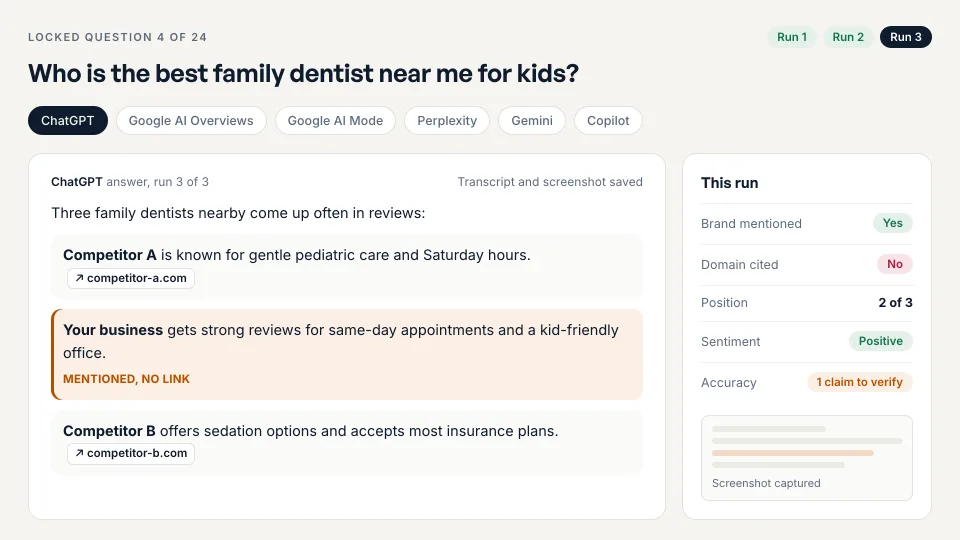
That gap is the reason this gets measured deliberately rather than inferred from a dashboard.
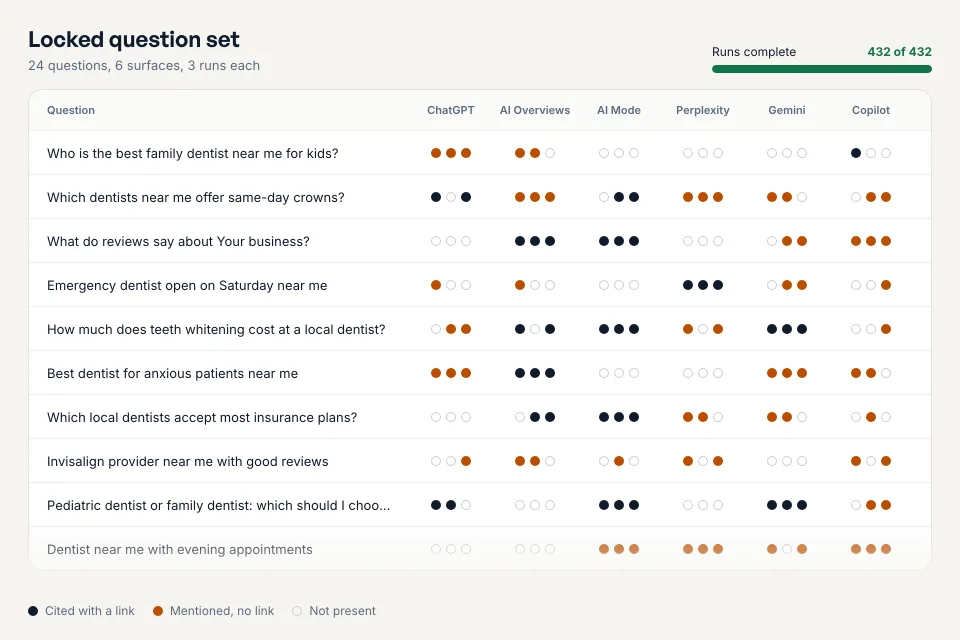
By asking it, on the record, the same way every time. We build a locked set of the questions your customers actually ask, run each one three times across every surface in scope, capture the transcripts and screenshots, and score the result against a fixed rubric. Lock the questions and the score becomes comparable quarter over quarter, which is the only way to prove anything moved.
Two analyses run underneath the score. The first asks whether your site can be found, read, and cited at all. The second asks what AI systems currently say about you, and how far that is from what you want them to say.
Named plainly, because these are the terms you will be comparing against other quotes: share of voice per engine, mention rate against citation rate, sentiment and accuracy, competitor comparison on identical questions, and coverage by service category. The audit page breaks each one down.
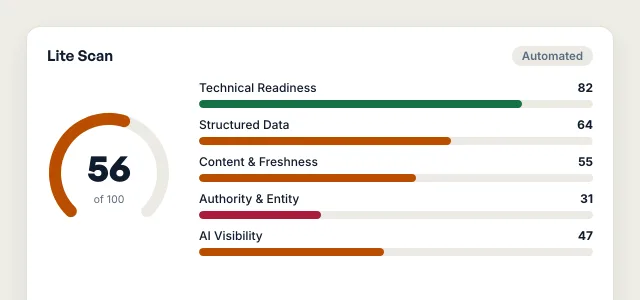
Each pillar carries equal weight in the composite AI Visibility Score.
Technical Readiness
Can AI crawlers reach your site, and does your page still have content when JavaScript is switched off?
10 checks
Structured Data & Extractability
Is there a machine-readable declaration of who you are, and is the page structured so an answer can be lifted out of it cleanly?
10 checks
Content & Freshness
Does your content answer real questions, in depth, recently enough to be cited?
7 checks
Authority & Entity
Do the third-party sources AI systems trust actually mention you, consistently?
7 of 9 live off your site
9 checks
AI Visibility
When we ask the real questions, do you appear, and what is said about you?
6 checks
Composite
AI Visibility Score
The number a Quarterly Recheck moves
42
checks across five pillars
The gap analysis that opens every engagement. It measures the distance between how AI describes you today and how you need to be described.
Visibility Gap
How often you are named, compared with your direct competitors
Narrative Gap
The distance between your intended positioning and how AI actually describes you
Topic Gap
High-value subjects where you have no AI-recognized authority
Format Gap
Content types AI systems prefer to cite that you have not produced
Web Mentions Gap
Absence from the third-party lists and directories AI uses to build consensus
Demand Gap
Branded and near-intent searches where you are not showing up at all
Five things, in order of depth. Most businesses enter at the audit and decide about remediation once they have seen it.
An automated score with no human probing and no manual verification. One page of results, produced quickly, to tell you whether there is a problem worth investigating.
Best for: Finding out if you have a problem at all.
The core product. A full five-pillar audit combining automated checks with manual probing across every surface, every client-facing finding verified by a human before it reaches you, delivered as a branded report with an evidence appendix and a walkthrough call.
Best for: Knowing exactly where you stand and precisely what to fix.
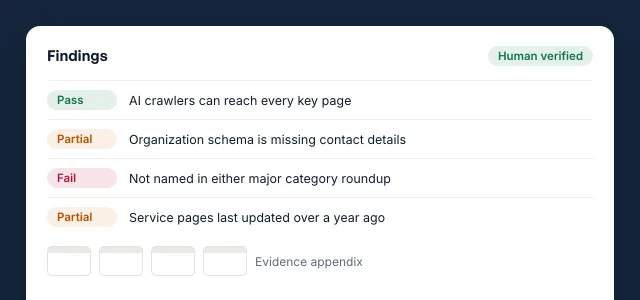
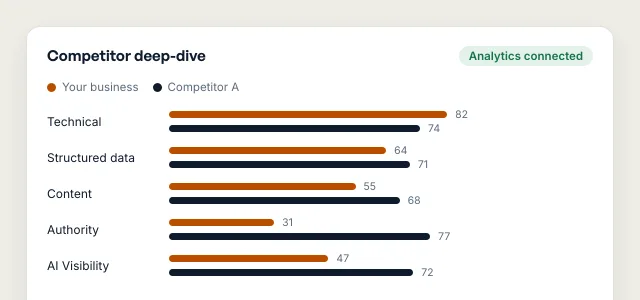
The core audit plus your own analytics integrated, an additional answer surface added to the probe set, and a competitor deep-dive.
Best for: Competitive categories, and businesses that need to see the gap against a specific rival rather than the field.
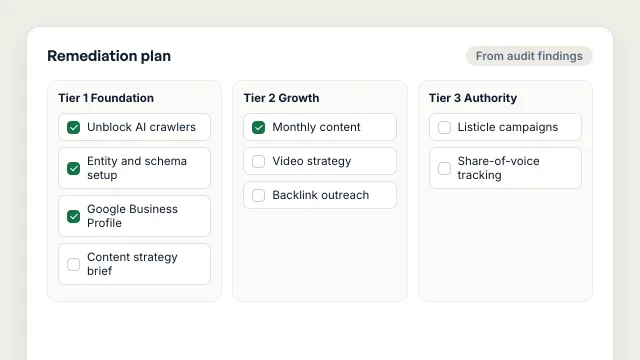
The fixes, scoped from your audit findings.
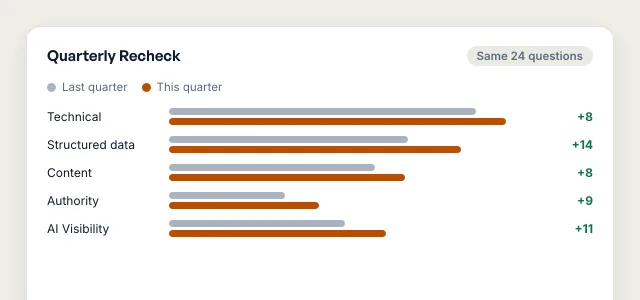
The same rubric and the same locked question set, rerun. You get a delta report showing exactly what moved.
Why it matters: This is the only honest way to prove the work did anything. A recheck against different questions is not a measurement, it is a new opinion.
Three comparisons come up on almost every call.
Those return a number. We sell judgment plus evidence: a human verifies every client-facing finding against the transcripts before it reaches you, and every failed check comes with what is wrong, what it costs you, and the specific fix. A score with no fix attached is a diagnosis with no prescription.
Those tools report continuously and well, and they are built for teams who already have the people to act on what they surface. We are the strategy and the hands. If you have a marketing department of one, a dashboard is another thing to check rather than a thing that gets fixed.
A traditional SEO audit does not examine AI surfaces at all. It will not tell you what ChatGPT says about you, whether Google AI Overviews cite you, or whether Google AI Mode names your competitor instead. Our report covers both layers, because the technical hygiene that helps one helps the other.
This work pays off when there is already something for an AI system to find and cite. If there is not, the honest answer is to build that first and audit later.
In practice, very little. AEO stands for answer engine optimization, GEO for generative engine optimization, and AI SEO is the loose umbrella term. All three describe the work of getting your business cited inside AI-generated answers. The industry has not settled on a winner, and both AEO and GEO are in active use. We use AEO because our methodology, rubric, and service tiers are already built around it.
No, and treating them as one thing is the most common mistake we see. Google AI Overviews are the AI-generated summaries inside the normal Google results page. Google AI Mode is a separate conversational interface. They cite the same URLs only 13.7% of the time (Ahrefs, 540,000 query pairs, 2025), so appearing in one is almost no evidence that you appear in the other. Both have to be probed and reported separately, and we do.
It depends on which pillar is holding you back. Technical fixes, such as an AI crawler being blocked or a page that renders empty without JavaScript, can change what a system can see within a crawl cycle. Authority and entity work, which is about third-party mentions and consensus, accrues over quarters. Anyone quoting you a fixed number of days is quoting a schedule they do not control.
No, and we would not trust a firm that did. What we can do is measure exactly where you stand today, fix every factor that is within your control, and rerun the identical question set each quarter so you can see what actually moved. That is a measurement, not a promise.
Yes. The technical foundation that ranks a page is largely the same foundation that lets an AI crawler read and cite it. AEO is a layer on top of good SEO, not a replacement for it. A site with broken canonicals and blocked crawlers fails both.
That is a Narrative Gap, and it is one of the six dimensions we measure. It is also more common and more fixable than most owners expect. Inaccurate answers usually trace back to thin or inconsistent entity information: a name, address, or service description that differs across your site, your Google Business Profile, and the directories that list you. Making those consistent is unglamorous and effective.
Yes, and they are two different jobs. Off-site sources largely decide whether you get mentioned at all: directories, review platforms, industry roundups, community discussion, and video are where these systems build their sense of who is worth naming in your category. Your own site decides whether you get cited as the source, whether what is said about you is accurate, and whether the visit turns into a customer. A system that has decided to recommend your kind of business still needs somewhere authoritative to point, and that is you. Your site is also the only part of the picture you control outright, which is why remediation starts there: two of the five pillars we score, Technical Readiness and Structured Data & Extractability, are entirely about your own website.
The uncomfortable part of this category is that you are already being described, whether or not anyone has checked. Somewhere in the answers your customers are reading, there is a version of your business that you did not write. The first useful thing anyone can do is go and read it.