Frequently asked questions.
The questions people actually ask before they get in touch, answered directly. If yours is not here, ask it. There is no obligation attached to a conversation.
About working with us.
What does Applied AI Strategies do?
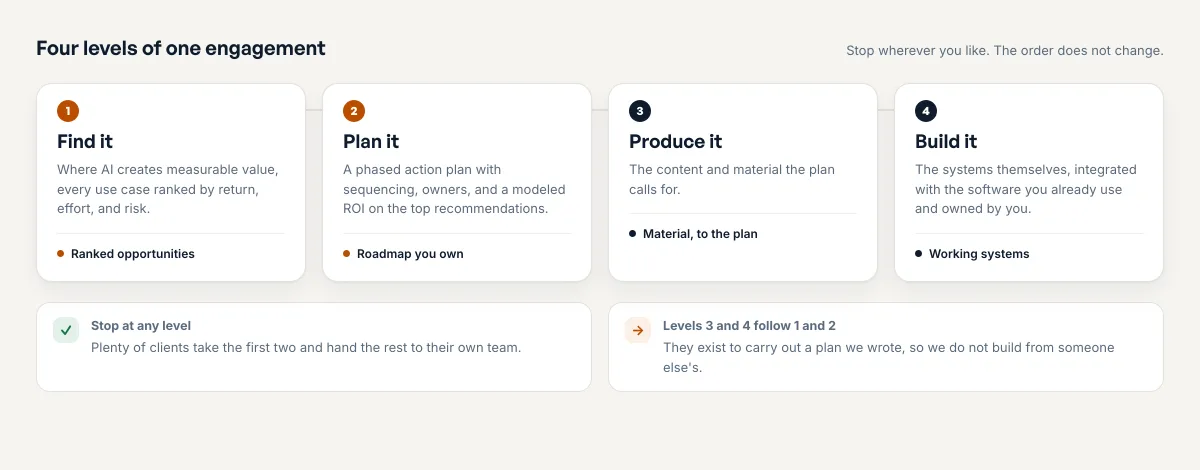
We are an AI strategy and implementation firm for small and mid-sized businesses. We find where AI creates measurable value in a business, rank the opportunities by return and effort, then build the systems and measure the result. We build what we recommend, and it stays our responsibility until it works.
Where should we start?
Almost always with an AI Readiness Assessment: two to four weeks inside your operations, ending in a costed roadmap you own whether or not you build anything with us. If your leadership team has not agreed AI is worth exploring at all, start with the AI Leadership Workshop instead. Either way the diagnosis comes first, because we build to carry out a plan we wrote rather than one handed to us. Compare all four
What size business do you work with?
Small and mid-sized businesses: owners, founders, CEOs, managing partners, and operations leaders. We are not built for enterprise procurement cycles, hundred-page RFPs, or organizations that need six committees to approve a workflow change, and we say so rather than pretending otherwise.
Do you work with our existing software?
Yes, and that is usually the point. Systems get built inside the tools your team already opens every morning. A system that requires everyone to learn a new place to work is a system that quietly stops being used.
Who owns what you build?
You do, outright. No vendor lock-in, no proprietary layer that stops working when you stop paying us. The systems, configurations, prompts, and documentation are yours, and everything keeps running if you end the engagement.
What if AI is not the right answer for our problem?
We tell you, in writing, and tell you what we would do instead. Every assessment includes a written statement of what is not worth automating. Honesty over salesmanship is the first of our four values, and a consultant who never says no is not giving you information.
How quickly do you reply?
Within one business day, from a person who has read what you wrote.
About cost and commitment.
How much does AI consulting cost?
We do not publish pricing, because the honest answer depends on scope and a published number would either anchor you wrongly or be a fiction. What we do publish is shape. The AI Readiness Assessment is fixed-scope and fixed-fee across 2 to 4 weeks. Implementation Sprints run 4 to 8 weeks per system. The Ongoing AI Partnership is a monthly engagement with a 12-month minimum initial term. You will have a real number before you commit to anything.
Why is there a 12-month minimum on the partnership?
Because the value of a standing partnership is accumulated context, and that takes time to build. A three-month version would spend most of its life on ramp-up and would be a worse deal for you than buying a sprint outright. The term is negotiable case by case, but 12 months is the shape we design for.
What ROI should we expect?
We do not publish an ROI figure, because any number quoted before seeing your operations would be invented. What we commit to is the method. Every engagement is anchored to one KPI agreed before work starts. The assessment models a return on the top recommendations using your numbers, with every assumption written down so you can challenge it. And we target a first measurable result within 90 days. If the modeled ROI does not justify the build, the assessment says so, and that is a legitimate outcome rather than a failed one.
Do we have to keep working with you after an assessment?
No. The roadmap is a standalone document written to be read by someone who was not in the room, precisely so you can implement it with your own team or hand it to another firm. It is built to be worth the money if you never speak to us again.
What are we committing to by getting in touch?
A half-hour conversation and nothing else. No cost, and no proposal unless we find something genuinely worth building. If it becomes clear on the call that we are not the right fit, we say so during the call rather than sending you something to decline. Schedule one
About AI itself.
How long before we see a result?
Every engagement targets a first measurable result within 90 days. That is a commitment we make at the start, not an average from past clients. The metric is agreed with you before work begins, and we report against it monthly.
How many hours can we realistically save?
Ten or more per week is the target we set when automating routine operations for a small team, measured against a baseline we establish before the build rather than estimated afterward. Whether a given business hits it depends on how much repetitive work there actually is, which is one of the things the assessment finds out.
Is our data safe?
Data handling is decided during scoping, in writing, before anything is built, and it is one of the standard governance items in every engagement rather than an add-on. What that looks like in practice depends on which systems are involved and what obligations your industry places on you, so it is a real conversation rather than a checkbox.
Will AI replace our staff?
That is not what we are hired to do, and it is not usually where the money is. The work we automate is transcription, summarizing, drafting, formatting, chasing, and re-entering information that already exists somewhere else. The point is to give skilled people their week back, not to reduce the number of them. If headcount reduction is your goal, say so early, because it changes what gets built and we would rather know.
We tried an AI tool and it did not stick. What was wrong?
Usually one of three things, and none of them is the tool. It lived somewhere nobody already worked, so using it required a new habit. It was tested on demo data rather than the messy real cases your business actually produces. Or nobody agreed in advance what success looked like, so there was no way to tell whether it was working. All three are addressable, and all three are cheaper to fix before a build than after.
About AI search visibility.
What is answer engine optimization?
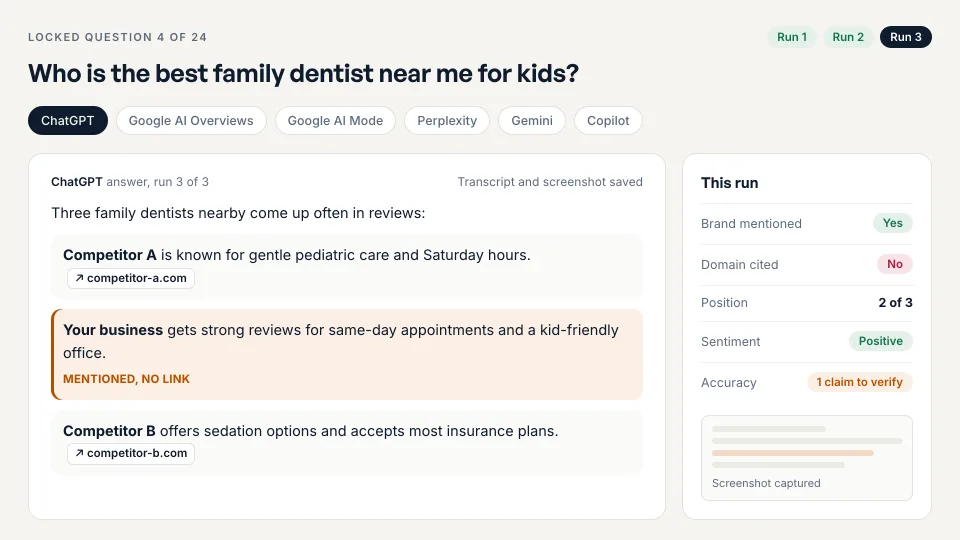
Answer engine optimization, or AEO, is the work of becoming the source an AI system cites when it answers a customer's question. The short version of the difference: SEO is about being findable, AEO is about being quotable. You will also see the same work called GEO or AI SEO, since the industry has not settled on one term. How it works
Our rankings are fine but traffic is down. Why?
Most likely because the answer is being given without you. Google AI Overviews now appear on 48% of all Google queries (SE Ranking and SeoProfy, 2026), and top organic results are seeing click-through fall by 15 to 46% (multiple studies, 2025 to 2026). Your position did not move. What sits above your position did.
Is Google AI Mode just another name for Google AI Overviews?
No, and the difference is worth knowing before you buy anything in this category. One of them lives inside the ordinary results page. The other is its own conversational product. Their citations overlap only 13.7% of the time (Ahrefs, 540,000 query pairs, 2025), so a report that treats them as a single surface is measuring roughly half of what it claims to. Ask any vendor which of the two they probed. The full explanation
Is AI search traffic actually worth having?
Yes, and disproportionately so. Visitors referred by AI search convert at 4 to 5 times the industry average (Ahrefs and Semrush, 2025), because they arrive already recommended rather than still comparing. There is less of it, and it is worth more per visit.
Can you really see what an AI tool says about us?
Yes, and you get the screenshots. Nothing about it is secret or clever: we ask the questions your customers ask, repeatedly, and record every answer. The part that takes skill is deciding which questions count, then never changing them, so the same measurement ninety days later means something. What the audit covers
How often does this need redoing?
Quarterly is the natural rhythm, because that is roughly how fast the freshness signal decays: 50% of AI citations come from content published or updated within the last 13 weeks (Amsive, 2025). A Quarterly Recheck reruns the identical rubric and questions and reports what moved.
Still have a question?
Ask it directly. We reply within one business day, and a question is a perfectly good reason to get in touch. You do not need a project.