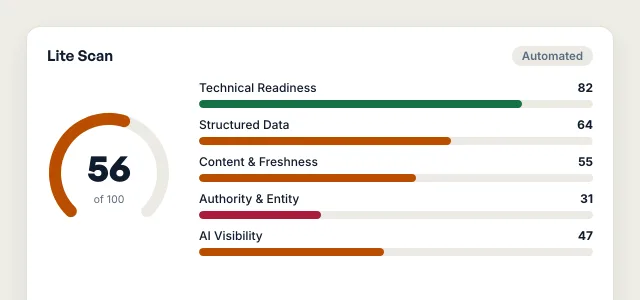
A composite AI visibility score
Scored against the same five-pillar rubric the full audit uses: Technical Readiness, Structured Data & Extractability, Content & Freshness, Authority & Entity, and AI Visibility. Each pillar carries equal weight.
A free automated scan of your site against the technical and structural checks that decide whether AI systems can read you, cite you, and describe you correctly. One page of results, back by email within two business days.
Two fields to submit, one page back, and nothing scheduled at the end of it. The result is yours whether you ever speak to us or not.

Businesses that suspect AI search is costing them something and want evidence before they spend anything on finding out properly. It answers one question: is there a problem here at all.
The usual trigger is a gap that does not make sense. Organic traffic has softened, rankings have held, and the analytics offer no explanation, because the traffic did not go to a competitor's listing, it stopped existing. Google AI Overviews now appear on 48% of all Google queries (SE Ranking and SeoProfy, 2026), and an answer given on the results page is an answer that never becomes a visit.
It is also for
One page. A composite score, the five pillar scores underneath it, and the checks that failed with what each one means.
Scored against the same five-pillar rubric the full audit uses: Technical Readiness, Structured Data & Extractability, Content & Freshness, Authority & Entity, and AI Visibility. Each pillar carries equal weight.
Where your site is strong and where it is not, so you can see whether the problem is technical, structural, or a matter of what has been published.
Not a list of error codes. Each failed check says what is wrong and why it matters to a business rather than to a developer.
This matters more than it sounds. Seven of the nine Authority checks live off your website entirely, and no automated scan can reach them. A pillar reading low on a Lite Scan often means nobody has looked yet, not that you scored badly. We say which is which, every time.
What you do not get
Three things, listed because leaving them out is how a scan gets mistaken for an audit.
Three steps and one form. Nothing is scheduled, and nobody calls you unless you ask them to.
Your website address and an email address to send the result to. Nothing else is required.
The automated checks are run against your site by us rather than by a public tool. That is a deliberate choice: a self-serve scanner has to be defended against abuse, and the defenses degrade the result. Running it ourselves means the scan is complete rather than rate-limited.
By email, within two business days. Nobody calls you, and nothing is booked. You will also get our occasional insight emails, and every one of them carries an unsubscribe link.
The Lite Scan is the smallest thing we offer, and for a good half of the businesses that run it the honest answer is that they should have gone straight to the audit.
If the scan says you are fine, that is a real result and there is nothing to buy. We would rather tell you that in one page than in four weeks.
Depth, evidence, and whether a person was involved. The scan tells you there is smoke. The audit tells you where the fire is, what it is costing, and what to do first.
| Lite Scan | AI Visibility Audit | |
|---|---|---|
| What it checks | Your website, automatically | Your website plus every answer surface that matters |
| Probing | None | A locked set of the questions your customers ask, run three times each, with transcripts |
| Human verification | None | Every client-facing finding verified by a person against the evidence |
| What you learn | Whether there is a problem | Exactly where you stand, what it costs you, and the specific fix for each failure |
| Delivered as | One page, by email | A branded report with an evidence appendix, plus a walkthrough call |
| Turnaround | Within two business days | Scoped at the start of the engagement |
| Mention rate, share of voice, sentiment | Not measured | Measured, against named competitors |
There is no upgrade path to buy and no credit to redeem. The scan is a separate thing that happens to be a sensible first one.
No. The result arrives by email and nothing is scheduled. If you want to talk about what it found, you reply to it, and if you do not, you keep the page. We would rather you came back in six months having read it than took a call you did not want this week.
Accurate about what it measures and silent about the rest, which is why the result says so explicitly. Automated checks are reliable on technical readiness and structured data, because those are machine-readable facts about your site. They cannot assess whether third-party sources describe you consistently, and they cannot ask an AI system anything. A scan that scored those anyway would be guessing, so ours reports them as unchecked.
No, and this is the single most common misunderstanding, so it is worth being blunt. Finding out what an AI system says about you means asking it, repeatedly, across several surfaces, and reading the transcripts. That is the audit. The scan checks whether your site is in a state to be found and cited in the first place, which is a different and earlier question.
Not through this form. Competitor comparison is part of the audit, where it is done properly against a named rival with the probing to support it. A one-page automated score on somebody else's site is not intelligence, it is a number without a context.
The website address and email are used to run the scan and send you the result. We do not sell data, and the privacy policy at /privacy/ sets out what is retained and for how long.
Two fields, one page back within two business days, and an honest answer about whether there is anything here worth doing something about. It is free, including when the answer turns out to be no.