Workflow mapping across the operations we scope together
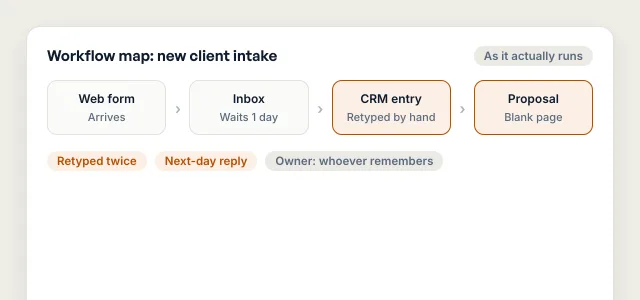
How work actually moves through your business, documented. Not the org chart, and not the process document nobody has updated since 2023.

Two to four weeks inside your operations, and a roadmap you could hand to anyone.
We map how your business actually runs, find where AI creates measurable value, and rank every opportunity by return and effort. You get a costed roadmap you own outright, not a slide deck of possibilities.
Fixed scope. Fixed fee. No obligation to build anything with us afterward.

Owners, founders, and operations leaders who suspect AI could help their business but have no reliable way to separate the real opportunities from the noise, and who are not willing to fund a build on a hunch.
In practice, most of the businesses that start here have the same three symptoms. Somebody on the team has been experimenting with AI tools and getting interesting results that nobody can scale. A vendor has pitched something expensive that may or may not fit. And nobody in the building can say with any confidence which of the twenty possible things to do would pay back first.
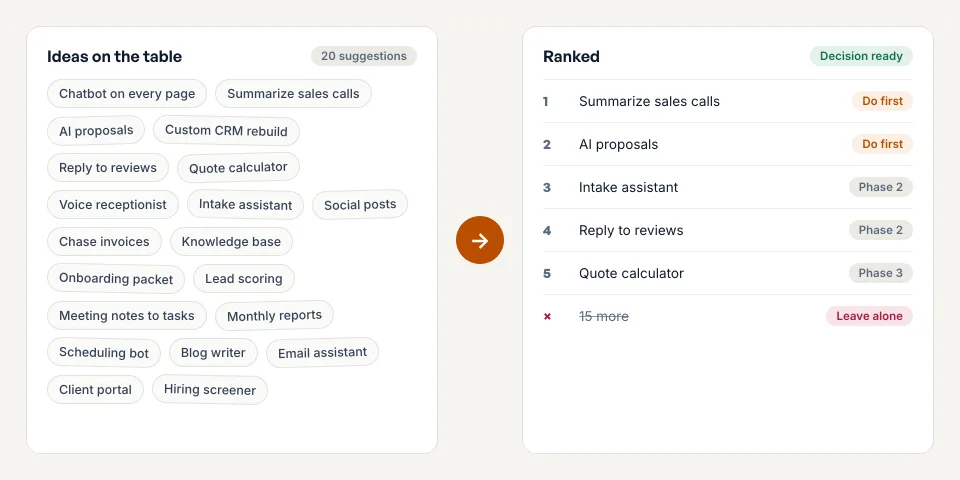
The assessment exists to end that specific paralysis. It replaces twenty maybes with a ranked list, a number attached to the top few, and a written statement of what to leave alone.
A written roadmap you own, plus the analysis behind it. Everything below is a deliverable, not a talking point.
How work actually moves through your business, documented. Not the org chart, and not the process document nobody has updated since 2023.
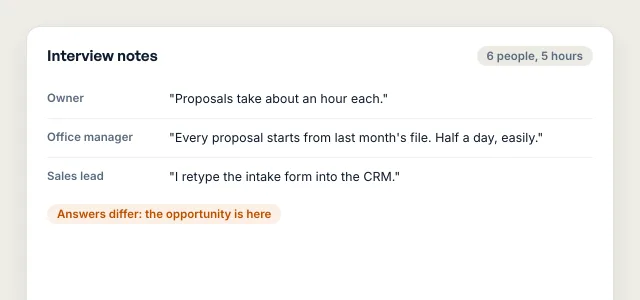
Not only the people describing it. Those two groups rarely give the same answer, and the difference between them is usually where the opportunity is hiding.
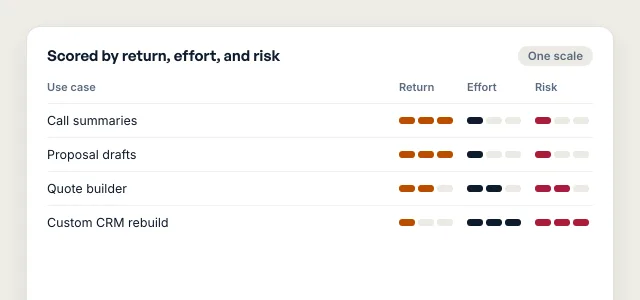
One consistent scale applied to everything, so the comparison is real rather than a matter of who argued hardest for their idea.
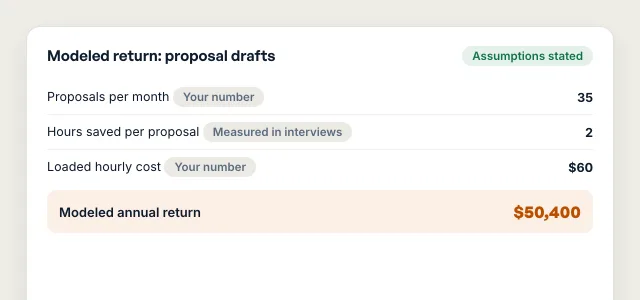
Return on investment built from your numbers and your assumptions, with the assumptions written down so you can argue with them. A model you cannot inspect is a guess wearing a suit.
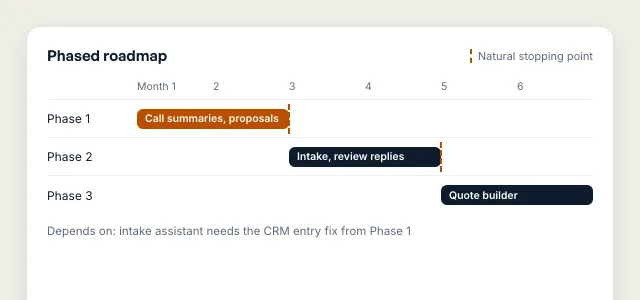
What to do first, what to do next, what depends on what, and where the natural stopping points are if you want to pause.
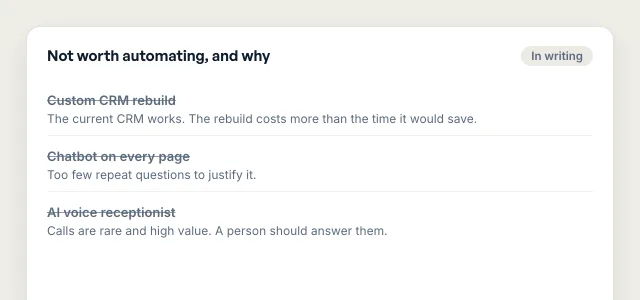
Usually the most useful page in the document. It is also the page that tells you what kind of firm you hired.
We take your team through the findings, answer the objections in the room, and leave the document with you.
The roadmap is yours. If you take it to another firm, or hand it to your own team, or put it in a drawer for six months, it still works. It was written to be read by someone who was not in the room.
Four stages across two to four weeks, depending on how many operations we scope. You will know at the end of each stage what we found and what it changes.
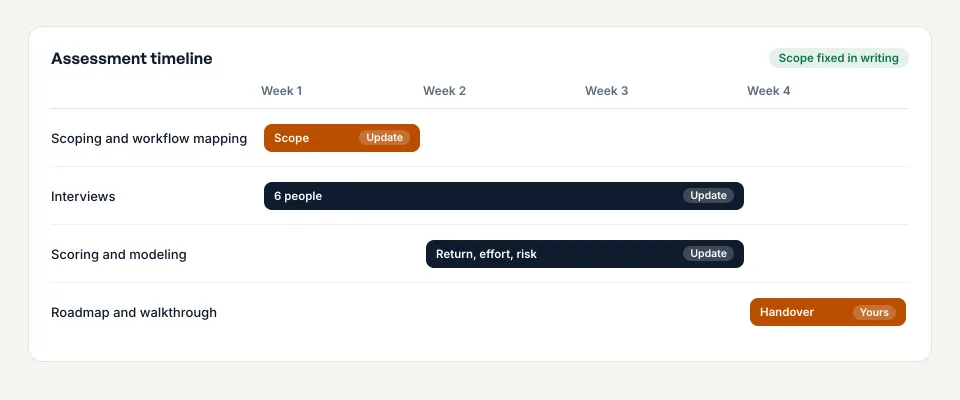
We agree what is in scope and what is not, then map how work actually moves through those operations. Scope is set in writing before anything else starts, which is what makes the fee fixed.
We talk to the people doing the work. This is the part that cannot be shortcut and the part that produces most of the findings. Expect us to ask your team what the annoying part of their week is, and to take the answer seriously.
Every opportunity we found gets scored by return, effort, and risk. The top recommendations get a modeled return built from your own numbers, with every assumption stated.
We write the phased roadmap, including what not to pursue, and walk your team through it. Then it is yours.
Roughly four to six hours of interview time spread across the people who do the work, access to the systems in scope so we can see how they are actually used, and one person empowered to answer scoping questions without a committee. That is the whole ask.
Not every business should buy this yet. Here is how to tell.
If two or more of those apply, say so on the call. We would rather point you somewhere cheaper than sell you the wrong thing and spend four weeks proving it.
Fixed scope, fixed fee, defined deliverable, and no obligation afterward.
An assessment that only makes sense as a step toward buying something else is a sales call with an invoice attached. This one is built to be worth the money if you never speak to us again, which is exactly why most clients do.
Workflow mapping across the operations we scope, interviews with the people doing the work, every opportunity scored by return, effort, and risk, a modeled return on the top recommendations, a phased implementation roadmap, a written statement of what is not worth automating, and a walkthrough session to hand it all over. It runs 2 to 4 weeks at a fixed scope and a fixed fee.
Two to four weeks. The variable is how many operations you put in scope, which is agreed in writing before work starts. Your team's own time commitment is roughly four to six hours of interviews plus the final walkthrough.
No. The roadmap is a standalone document that you own. You can implement it with your own team, take it to another firm, or shelve it. It was written to be read by someone who was not in the room, precisely so that stays possible.
Then that is what the report says, and we will tell you before we finish rather than saving it for the last page. It has to be a real possible outcome for the exercise to be worth anything. An assessment that always recommends buying more is not an assessment.
A consultation is scoped to produce a proposal. An assessment is scoped to produce a decision document, and the two are not the same object. We will happily spend half an hour with you at no cost, because that half hour is how we both work out whether there is anything here. What we will not do is give away four weeks of interviews, scoring, and modeling, because a firm that does is being paid by whatever it recommends next.
One person empowered to answer scoping questions without convening a committee, and access to the people who actually do the work in the operations we scope. Leadership sets the scope. The findings come from the floor.
Bring us the list of things somebody has suggested and nobody has ranked. That is the raw material, and half an hour with it is usually enough for us to say whether an assessment is the right next step or whether something smaller would answer your question for less.
Not ready to talk? The /faq/ page answers the questions people usually ask before they get in touch.