Published
Where AI actually pays in a small business.
Not everything that can be automated should be. Here is the framework we use to find candidates, and the arithmetic we use to throw most of them out.
The problem with AI advice for small businesses is that it is either a list of tools or a list of predictions, and neither tells you what to do on Monday. What an owner actually needs is a way to look at their own operation and tell which parts of it would pay and which would waste a quarter.
This is the method we use. It has two halves: four questions that generate candidates, and one test that eliminates most of them.
The four questions
We ask these about any business, in this order, because they map to the four things a business can actually improve.
What could we do faster? Look for skilled people spending hours on work that produces no judgment: transcribing, summarising, drafting, formatting, chasing, and re-entering information that already exists somewhere else in the business.
What could we offer that used to be too expensive or too complicated? Things you would have needed to hire for, or build a department around, and therefore never did. Guided tools that help a customer choose. Assistants that answer at eleven at night. Intake that structures itself before anyone reads it.
What would make this work more profitable? Not more sales. The same sales, costing less between the quote and the invoice. Faster quoting, better-qualified leads, scope that holds, change requests that get flagged as billable instead of absorbed.
What could we repeat without hiring? Work that currently only happens because a specific person does it. The expertise living in one head and one calendar, which is the ceiling almost every owner-led business eventually hits.
A fifth question has become unavoidable since AI systems started answering customers directly: can our customers still find us? That one belongs to a different discipline and has its own pages here.
Four questions run across an operation will produce twenty candidates in an afternoon. That is the easy half. The valuable half is what happens next.
If you would rather start from examples, 100 Ways AI Pays lists a hundred candidates already sorted under these four questions.
The test: is this task worth automating?
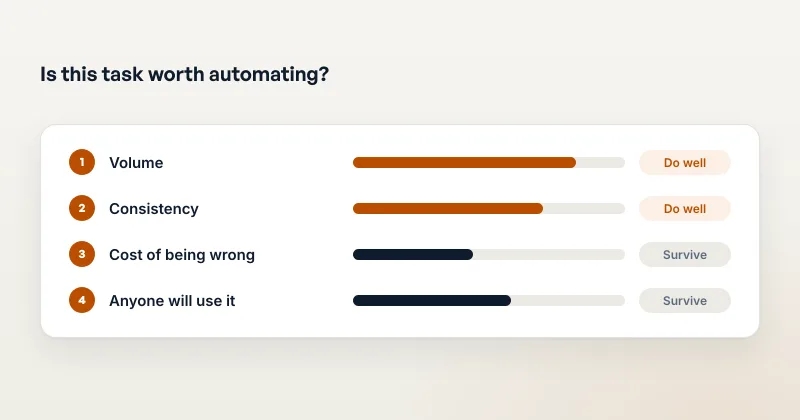
Four factors, and a task needs to do well on the first two and survive the last two.
1. Volume. How many times does this happen? Not “how long does it take” but “how often”. A two-hour task done twice a year is worth less attention than a four-minute task done forty times a week, and owners consistently rank these the wrong way round, because the two-hour task is the one that feels painful.
2. Consistency. Does it happen the same way every time? A task with one path is straightforward. A task with three paths is a project. A task where the right answer depends on knowing the client, the history, and something nobody wrote down is a task for a person, at least for now.
3. Cost of being wrong. What happens when the output is wrong and nobody notices? A misfiled internal note is a shrug. A wrong price sent to a customer is a real problem. This factor does not disqualify a task, it decides how much checking has to be built around it, and that checking is part of the cost.
4. Whether anyone will actually use it. The one that kills most projects and appears on no framework. If the new way requires somebody to change a habit they have held for nine years, and the old way still works, the old way wins. Systems that survive get built into the path the work already takes.
Working the arithmetic
The first two factors turn into a number, and it is worth doing on paper before anyone quotes you anything.
These are illustrative figures, not a client result. Put your own numbers in.
Take a task that takes 12 minutes and happens 30 times a week. That is 6 hours a week, or roughly 300 hours a year, or most of two months of one person’s working time on a single repeated task.
Now apply the honest discount. Automation rarely removes a task, it shrinks it. Assume the person still spends 3 minutes reviewing and correcting each output, because they should. Twelve minutes becomes three. You have recovered 4.5 hours a week rather than 6, which is still 225 hours a year.
Then ask the question that decides it: is 225 hours of that person’s time worth more than the build and the ongoing cost of running it? If the answer is not obvious, the answer is no. Marginal cases consume the same attention as clear ones and deliver a fraction of the return, which is why our own assessments rank by return, effort and risk rather than listing everything possible.
Run the same arithmetic on the two-hour task done twice a year. Four hours. There is nothing there, and that is the point of doing it on paper.
Five things that look automatable and are not
Or at least, not first.
1. Anything you cannot describe. If two experienced people in your business would produce different outputs and both would be right, there is no rule to encode yet. Write the rule down first. Sometimes that exercise is the whole value and no software is needed.
2. Work that is already rare. See the arithmetic above. The pain of a task and the cost of a task are different quantities.
3. Your genuinely differentiating work. The thing customers pay you for specifically. Automating it saves you time and removes the reason you are chosen. Automate what surrounds it so there is more time for it.
4. A process everyone is about to change anyway. Automating a workflow two months before it is redesigned means building the wrong thing carefully.
5. Anything where the failure is silent. If a wrong output looks exactly like a right one and nobody would catch it, the checking cost exceeds the saving. Either build the check first or leave it alone.
Why the biggest opportunity is rarely the obvious one
The thing an owner names in the first ten minutes is almost never the thing worth doing first. Not because owners are wrong about their business, but because the tasks that come to mind are the ones that are annoying, and annoyance tracks how unpleasant work is rather than how much of it there is.
The high-volume, low-drama work is invisible precisely because it is tolerable. Nobody complains about it. It just quietly consumes four hours a week from someone who is expensive.
This is also why we interview the people doing the work rather than only the people describing it. Those two groups reliably give different answers, and the difference is usually where the opportunity is sitting.
How to decide without guessing
You can run all of this yourself, and if you have twenty candidates and the time to score them, you should. The framework above is the whole method, not a teaser for it.
What a formal assessment adds is the part that is tedious rather than clever: timing the tasks instead of estimating them, interviewing across the operation rather than asking the owner, modelling the return on the top handful rather than eyeballing it, and writing down what is not worth automating so nobody revisits it in six months.
That last document is often the most useful page in the report.
Two to four weeks, fixed scope, and a phased roadmap you own whether you build anything with us or not.