Published
Your rankings held. Your traffic dropped. Here is what happened.
Position one is not what it used to be worth. Before you accept that as the explanation, though, there are five duller causes that produce the same chart, and you should eliminate them first.
The short answer
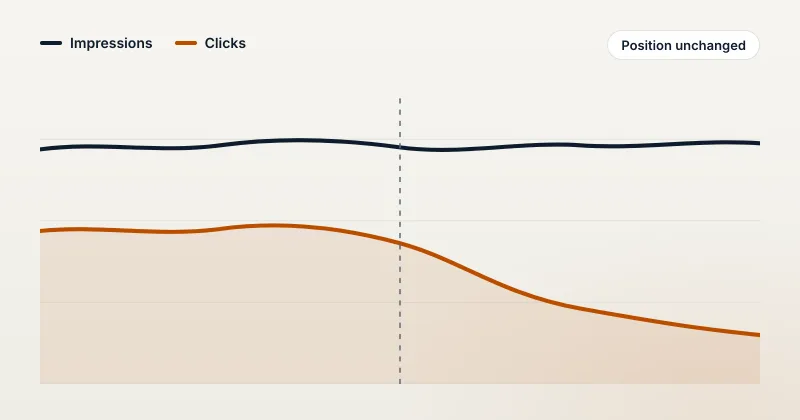
The answer is being given without you. A customer typed a question, an AI-written summary answered it above the links, and the visit that used to follow never happened. Your position report is accurate and no longer describes what a user sees.
Google AI Overviews now appear on 48% of all Google queries (SE Ranking and SeoProfy, 2026), and top organic results are seeing click-through fall by 15 to 46% (multiple studies, 2025 to 2026). Nothing about your ranking changed. What sits above your ranking did.
That is the likely answer. It is not automatically your answer, which is the rest of this article.
First, rule out the five ordinary explanations
We would rather you spent an hour on this than bought a measurement you did not need. Every one of these produces a chart that looks the same from a distance, and every one is cheaper to fix.
1. Seasonality. Compare against the same period last year rather than against last quarter. A great many “unexplained declines” are August, or the fortnight after a holiday, and the year-on-year view kills the theory in about four minutes.
2. A tracking change. Did anything touch the analytics in the window? A consent banner change, a tag manager edit, a new subdomain, a switch of analytics platform, an ad blocker share shift. Traffic that stops being recorded looks exactly like traffic that stops arriving. Check whether server logs or your CRM show the same drop. If they do not, you have a measurement problem and not a market problem.
3. A conventional algorithm update. Rankings can hold on the terms you track while falling on hundreds you do not. Look at total impressions in Search Console, not at your rank tracker. Rank trackers watch the queries you chose, which is a small and flattering sample.
4. A competitor did something. Somebody published a genuinely better page, or bought their way above you, or opened a location closer to your customers. This shows up as a decline concentrated in a handful of query families rather than spread across everything.
5. You changed something. Site migration, URL structure change, a redesign that dropped internal links, a robots.txt edit, a CDN rule, a page that quietly started requiring JavaScript to show its content. Check the date of the drop against your own deployment history before you look anywhere else. This is the single most common real cause and the most embarrassing one to discover after paying for an audit.
If any of those five explains it, stop here. You have your answer and it is fixable without us.
The signature of an AI answer problem
If the five are ruled out, there is a pattern that distinguishes this cause from the others. Four things tend to be true together.
Impressions hold and clicks fall. This is the clearest single indicator. Google Search Console still records you being shown for the query. Fewer people click. You are still in the list, and the list is being read less because something above it answered the question.
The loss concentrates on informational queries. Questions beginning “what”, “how”, “why”, “best way to”, and “is it worth”. These are the queries an AI summary can finish on its own. Transactional and branded queries, where somebody wants to buy or wants you specifically, hold up far better. If your decline is evenly spread across every query type, look again at the five.
Your click-through rate falls at a stable position. Not your position. Your rate. If you were at position three getting a certain share of clicks and you are still at position three getting substantially fewer, something changed about the page, not about you.
Branded and direct traffic hold, or even rise, while the total falls. This one is counter-intuitive and it is the tell that people miss. It happens because a customer who hears your name inside an AI answer, without a link, then goes and searches for you by name. Your reporting files that as branded search or direct.
Why your analytics make it look smaller than it is
Two different things happen when an AI system talks about your business and only one of them reaches your reporting.
Being cited means a clickable link. It sends a visitor and the visitor is counted.
Being mentioned means your name in the answer with nothing to click. Only 23.1% of AI brand mentions include a citation back to that brand’s own domain (BuzzStream, 12,000 AI responses, 2026), so most of what happens to you is the second kind. It sends nobody directly and your dashboard records nothing at all.
So the influence is running at roughly four times what your reporting can see, in both directions. Businesses being recommended are getting credit for it somewhere in their branded search line without knowing why. Businesses being left out are losing ground with no line item to point at.
This is also why the loss is easy to misread as small. What you can measure is the citation half. The half you cannot measure is the larger one.
What this does not mean
Three conclusions people jump to, all wrong.
It does not mean SEO stopped working. The technical hygiene that ranks a page is the same hygiene that lets a crawler reach and read it. Everything you have built is the foundation this sits on, not a sunk cost. A business with no organic presence at all does not get cited by AI systems either.
It does not mean traffic is the only thing that matters. The visits still arriving are better than the ones that stopped. Visitors referred by AI convert at 4 to 5 times the industry average (Ahrefs and Semrush, 2025), because they arrive already recommended rather than still comparing. A smaller, better-qualified stream is not automatically a worse business.
It does not mean somebody can guarantee you a place in the answer. Nobody can sell you that and anybody offering it is describing something they do not control. What can be sold is a measurement, a fix list, and a rerun that shows whether the fixes worked.
What to do about it
In order, cheapest first.
- Rule out the five. An hour, and it settles most cases.
- Look, once. Ask the questions your customers ask, in an AI tool, signed out, three times each. You will know within ten minutes whether you are in the answer.
- Fix your details everywhere. Consistent name, address, service list and description across your site, your Google Business Profile, and the directories you appear in. Inconsistent entity details are a direct cause of AI systems answering wrong about a business, and this is the cheapest work in the discipline.
- Then measure properly, if the first three suggest there is something here. Properly means every surface probed separately, a locked question set so the next measurement is comparable, and evidence attached to every finding.
Every surface probed individually, three runs per question, and a fix list where each item carries the business consequence and the owner.