Published
Google AI Overviews and Google AI Mode are not the same thing.
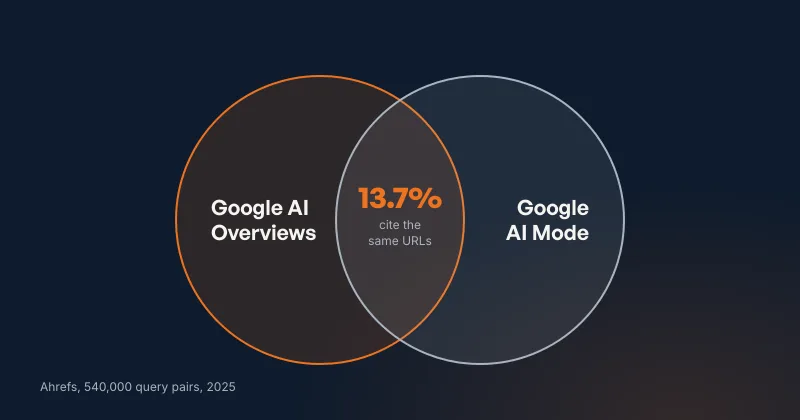
Same company, same underlying models, two entirely different surfaces. They cite the same URLs only 13.7% of the time (Ahrefs, 540,000 query pairs, 2025), which means anyone reporting on one and calling it “Google AI” is showing you a coin flip.
The short version
Google AI Overviews is the AI-written answer that appears at the top of a normal Google results page, above the links. You did not ask for it and you cannot avoid it.
Google AI Mode is a separate conversational interface. You choose to enter it, and then you have a back-and-forth rather than a search.
They are built by the same company on related technology, and they behave differently enough that being cited in one is close to no evidence that you are cited in the other. Google AI Overviews and Google AI Mode cite the same URLs only 13.7% of the time (Ahrefs, 540,000 query pairs, 2025). On the top three citations specifically, the overlap rises only to 16.3%.
If you take nothing else from this: they have to be measured separately, and any report that gives you one number for “Google AI” has measured one of them and guessed at the other.
What is Google AI Overviews?
An AI-generated summary that sits at the top of the standard results page, ahead of the organic links, drawing on several sources and citing some of them.
Three things follow from where it sits.
It reaches people who never asked for AI. Nobody opts in. It appears on 48% of all Google queries (SE Ranking and SeoProfy, 2026), which makes it by far the highest-volume AI surface any business is exposed to.
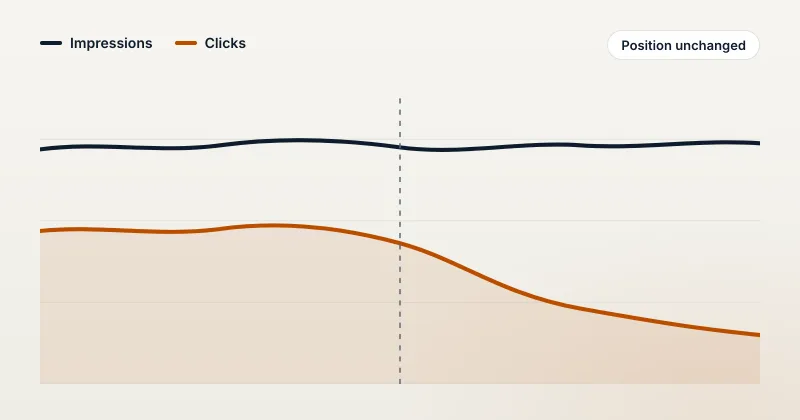
It competes directly with your ranking. Your position has not moved. The thing above your position has. Top organic results are seeing click-through fall by 15 to 46% (multiple studies, 2025 to 2026), and that is the mechanism behind most of the unexplained traffic drops businesses have been reporting.
It stays close to the query. Because it is answering a typed search rather than holding a conversation, the sources it pulls tend to track conventional search relevance more closely than the conversational surfaces do. Not identically, but closer.
What is Google AI Mode?
A deliberate, conversational interface. The user chooses it, asks a question in natural language, gets an answer, and then asks a follow-up that assumes everything already said.
Three things follow from that.
The user is further along. Somebody who enters a conversational mode is usually researching a decision rather than looking up a fact, which makes the audience smaller and considerably more valuable.
It rarely sends anyone anywhere. Google AI Mode ends 93% of its sessions with zero clicks to any website (Semrush, 69 million sessions, 2026). The whole interaction is designed to conclude inside the conversation.
The follow-up questions are where you get compared. The first answer names some businesses. The second and third answers are where a user asks which is better, cheaper, faster, or right for their situation, and that is where a recommendation actually gets made. A measurement that only captures the opening answer is missing the part that decides the sale.
How different are they really?
| Google AI Overviews | Google AI Mode | |
|---|---|---|
| How you reach it | Automatic, on an ordinary search | Deliberate, you enter it |
| Interaction | One answer, then the results page | A conversation with follow-ups |
| Reach | 48% of all Google queries (SE Ranking and SeoProfy, 2026) | Far smaller, and self-selected |
| Clicks out | Reduced. Top organic click-through down 15 to 46% (multiple studies, 2025 to 2026) | Almost none. 93% of sessions end with zero clicks (Semrush, 69 million sessions, 2026) |
| User intent | Mixed, mostly informational | Researching a decision |
| Where you win or lose | The single answer | The follow-up comparison |
The overlap in what they cite is 13.7% (Ahrefs, 540,000 query pairs, 2025). Two surfaces from one company, on the same query, agreeing on sources roughly one time in seven.
Why almost everyone collapses the two
It is an easy mistake and worth naming, because the people making it are not careless.
Both are Google. Both are AI. Both arrived within a short window and were covered in the same articles. Google’s own naming does not help either, since Google AI Overviews and Google AI Mode differ by one word and describe things a non-specialist would reasonably assume are the same feature at two sizes.
And the tooling encourages it. Plenty of platforms report a single “Google AI visibility” metric, because one number is easier to sell than two. The number is not fabricated. It is just a measurement of one surface being presented as coverage of both.
What this changes for your business
Four practical consequences.
1. Both get measured, separately, or neither is measured. A visibility report that does not tell you which surface each result came from cannot tell you where you stand. This is not a refinement, it is the difference between a measurement and an average of two unrelated things.
2. Your priority depends on which one your customers use. A business selling something people look up gets more from Google AI Overviews. A business selling something people deliberate over, where the decision takes research and comparison, has more at stake in Google AI Mode even though the volume is far lower.
3. The foundations are shared, so the work is not doubled. This is the good news, and it is why the distinction is a measurement problem more than a budget problem. Being crawlable, being structured so an answer can be lifted out cleanly, having a coherent machine-readable declaration of who you are, and being described consistently across the third-party sources these systems trust all help on both. Roughly 80% of AI citations come from third-party sources rather than a brand’s own content (BuzzStream, 12,000 AI responses, 2026), and that is true across surfaces.
4. What differs is depth versus breadth. Getting into Google AI Overviews rewards clean, direct answers to the specific question. Getting recommended in a Google AI Mode conversation rewards being the business that holds up under a follow-up: real detail, real differentiation, and third-party corroboration that survives “why them and not the other one”.
The question to ask any vendor
If you are being pitched AI search visibility work, ask this: which surfaces did you probe, individually, and can I see the results split by surface?
A vendor probing both will answer immediately and show you two sets of numbers. A vendor who has measured one and inferred the other will produce a blended figure, or explain that the difference does not matter much.
It matters roughly six times in seven.
Two common questions
If we optimise for one, do we get the other for free?
Partly, and not enough to rely on. The technical and structural foundations carry across, which is most of the work. What does not carry across is which specific pages get cited on which specific questions, and that is what actually decides whether you are named. Treat the shared foundations as the efficient part and the surface-level results as two separate measurements.
Which one should we care about more?
Whichever one your customers are in, and you find that out by measuring both once rather than by guessing. As a starting bias: higher-volume, lower-consideration purchases lean toward Google AI Overviews, and higher-value, longer-consideration purchases lean toward Google AI Mode. Neither bias is strong enough to skip the measurement.
Every surface probed individually, three runs per question, transcripts attached, and the results split by surface rather than blended.