Published
What ChatGPT actually says about your business.
Most owners have never once looked. It takes ten minutes, the results are usually a surprise, and there are five patterns you are likely to see.
Ask ChatGPT to recommend a business like yours in your city, and it will answer. It will not say “I do not know.” It will produce a confident, well-written paragraph naming two or three companies and explaining why they are a good choice. Whether your name is in that paragraph is a fact about your business that you can check today, and almost nobody has.
That is the odd thing about this shift. Every other marketing channel a business worries about has a dashboard attached. This one has no login, no report, and no notification when it changes, and it is answering questions about you constantly.
Why this is worth knowing
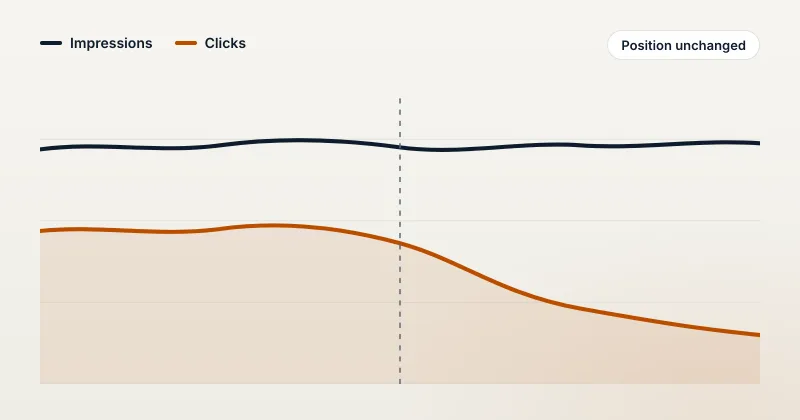
Because the answer increasingly replaces the search. Google AI Overviews now appear on 48% of all Google queries (SE Ranking and SeoProfy, 2026), and Google AI Mode, which is a separate conversational surface rather than the same feature under another name, ends 93% of its sessions with zero clicks to any website (Semrush, 69 million sessions, 2026).
The commercial consequence is simple. If a customer asks for a recommendation and gets three names, the comparison is over before anyone visits a website. Being the fourth-best option on a page nobody reaches is the same as not existing.
The upside, and there is one, is that the traffic which does arrive is better. Visitors referred by AI convert at 4 to 5 times the industry average (Ahrefs and Semrush, 2025), because they arrive already recommended instead of still deciding. Fewer visits, better visits. That trade only works in your favour if you are the business being recommended.
What you will actually see: five patterns
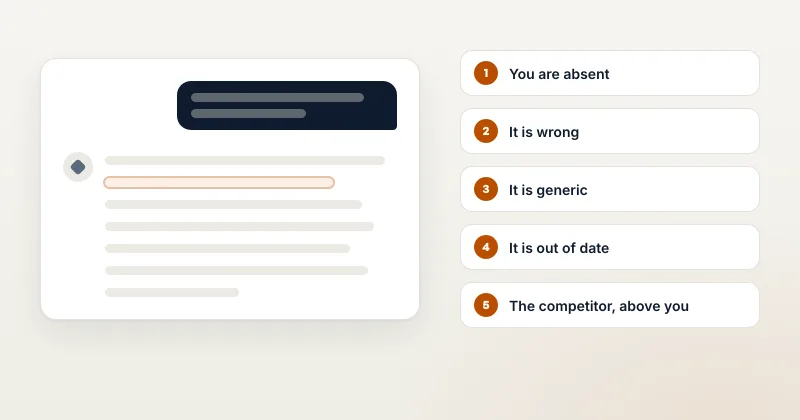
We have run this exercise across a lot of businesses. What comes back sorts into five patterns, and most businesses are in more than one at the same time.
1. You are absent
The most common result, and the least dramatic to look at. The answer is complete, helpful, and names three competitors. Nothing is wrong with it except that you are not in it.
Absence is rarely about quality. It is usually about the AI system having no consistent, machine-readable evidence that you exist in that category, which is a fixable problem and not a judgment about your work.
2. You are there and it is wrong
The second most common, and the most urgent. Wrong service list. Wrong location or service area. A service you stopped offering three years ago. A price band you never had. Occasionally a merger or a closure that never happened.
Inaccuracies are usually the cheapest thing to fix and the most expensive thing to leave, because they are being repeated to every customer who asks, in a confident voice, with no way for you to see it happening.
3. You are there and it is generic
You get named, and the description could apply to any of your competitors. “A local provider offering a range of services.” Nothing wrong, nothing memorable, nothing that would make a reader choose you.
This is a positioning problem wearing a technology costume. AI systems summarise from what exists about you. If everything written about your business is interchangeable, the summary will be too.
4. You are there and it is out of date
The description is accurate about the business you were. New service lines missing, a rebrand not reflected, an old address, a former partner still attached to your name.
This one has a mechanism behind it: these systems strongly prefer recent material, and 50% of AI citations come from content published or updated within the last 13 weeks (Amsive, 2025). If the most recent substantial thing written about you is four years old, the four-year-old version of you is the one being described.
5. You are there and so is the competitor, above you
You are named second or third, with a comparison attached that favours somebody else. This is the pattern owners find hardest to read and the most useful one to have.
It is also the only pattern where the answer tells you exactly what to do, because the reason given for preferring the competitor is usually something concrete: they have more reviews, they publish more, they are listed somewhere you are not, or a third-party roundup includes them and omits you.
How to check yours in ten minutes
You do not need us for a first look, and we would rather you did it than took our word for it.
- Write down the question a customer would actually type. Not your company name. Nobody who does not know you searches for you. Write the category and the place: “best commercial electrician in Melbourne Florida”, “who should I use for a pre-cruise massage in Port Canaveral”.
- Ask it in a signed-out or private window, in ChatGPT and in at least one other tool. Signed in, you get answers shaped by your own history, which will flatter you.
- Ask the same question three times, in three separate conversations. These systems do not answer identically twice, and one answer is an anecdote.
- Screenshot everything, including the answers that mention nobody.
- Then ask a follow-up: “why did you recommend those?” The reason it gives is the closest thing to a fix list you will get for free.
Do that and you will know which of the five patterns you are in. That is genuinely useful and it costs nothing.
Why your ten minutes is not a measurement
It is worth being straight about the limits of what you just did, because the gap is the whole reason a measured version exists.
Three runs of one question is a sample of one question. A real question set covers every service you sell and every way a customer might phrase it, and it is locked so that it can be rerun identically later.
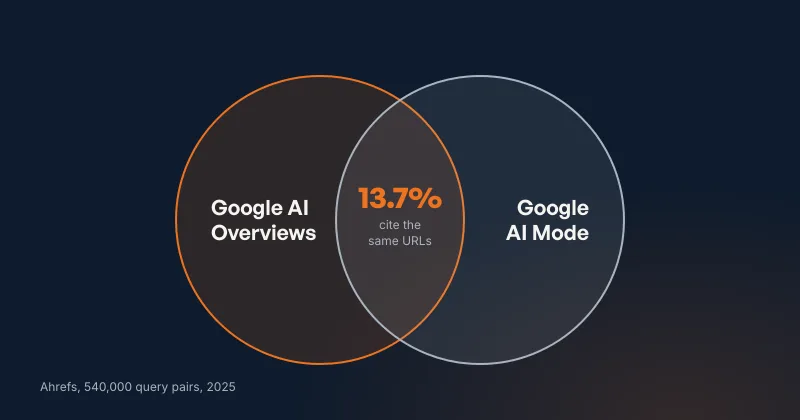
One surface is not the picture. ChatGPT is not Google AI Overviews, and Google AI Overviews is not Google AI Mode. Those last two are both Google and they cite the same URLs only 13.7% of the time (Ahrefs, 540,000 query pairs, 2025). Being in one tells you almost nothing about the other.
You have a snapshot with nothing to compare it to. The value of a baseline is not the number, it is the second number ninety days later. Without a locked question set, a rerun is a new opinion rather than a measurement.
And you now know what, but not why. The gap between “we are absent” and “we are absent because our schema does not declare what we do, our Google Business Profile categories are wrong, and the three industry roundups our competitors sit in have never heard of us” is the entire job.
What to do with what you found
If you saw pattern 2, the wrong information, fix that first regardless of anything else here. Correct your Google Business Profile, correct your own site, and correct the largest directories you appear in. Consistent details across the places these systems read is the cheapest work in this whole discipline and it is the foundation everything else sits on.
If you saw patterns 1, 3, 4 or 5, the honest next step is to find out how deep it goes before spending anything on fixing it. That is what a scan is for.
Two fields, one page back within two business days, and an honest answer about whether this is worth your attention. If it is not, we will say so.